
Ecommerce sites need a different SEO strategy because they rely on hundreds or thousands of pages working together to attract shoppers. That changes how you approach site structure, keyword targeting, and the pages you prioritise.
The problem is that most store owners pull from the same general SEO advice everyone else uses. Much of that advice works well for service businesses and content sites, but ecommerce websites face different ranking challenges. Applying the wrong approach can leave the pages that drive sales struggling to gain visibility.
This article breaks down the main differences between ecommerce and service business SEO. By the end, you’ll know exactly where your current strategy might be falling short and what to do about it.
Your SEO Strategy Might Be Built for the Wrong Kind of Website
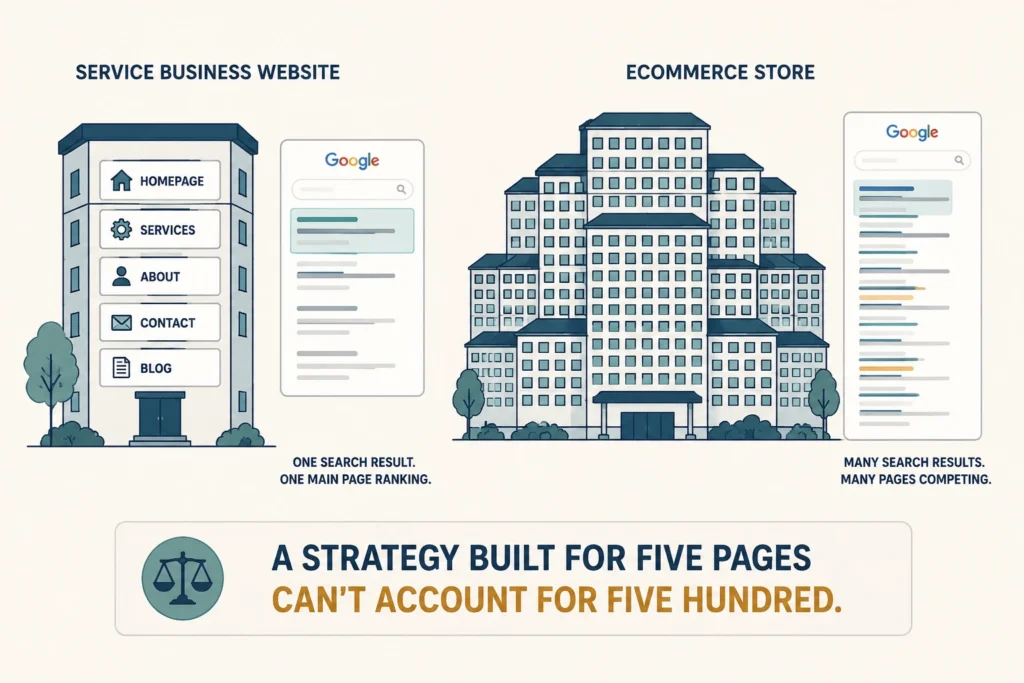
Service businesses typically focus their SEO efforts on a small number of pages targeting local searches and core keywords. For example, a plumber in Brisbane needs their service page to appear when someone searches “plumber near me.” Once those core pages perform well, the business has already covered many of the searches that directly generate leads.
Ecommerce stores work differently. An outdoor gear store may have hundreds of product and category pages targeting different searches across the buying journey. The thing is, a strategy targeting five or ten key pages can’t account for that scale. As a result, large parts of the store have little chance of appearing in search results.
That’s the core problem with applying a service-site SEO strategy to an ecommerce website. Ecommerce websites have more pages, greater complexity, and a much bigger risk of losing visibility when the wrong approach is applied.
Service Businesses and Ecommerce Sites Have Opposite SEO Goals
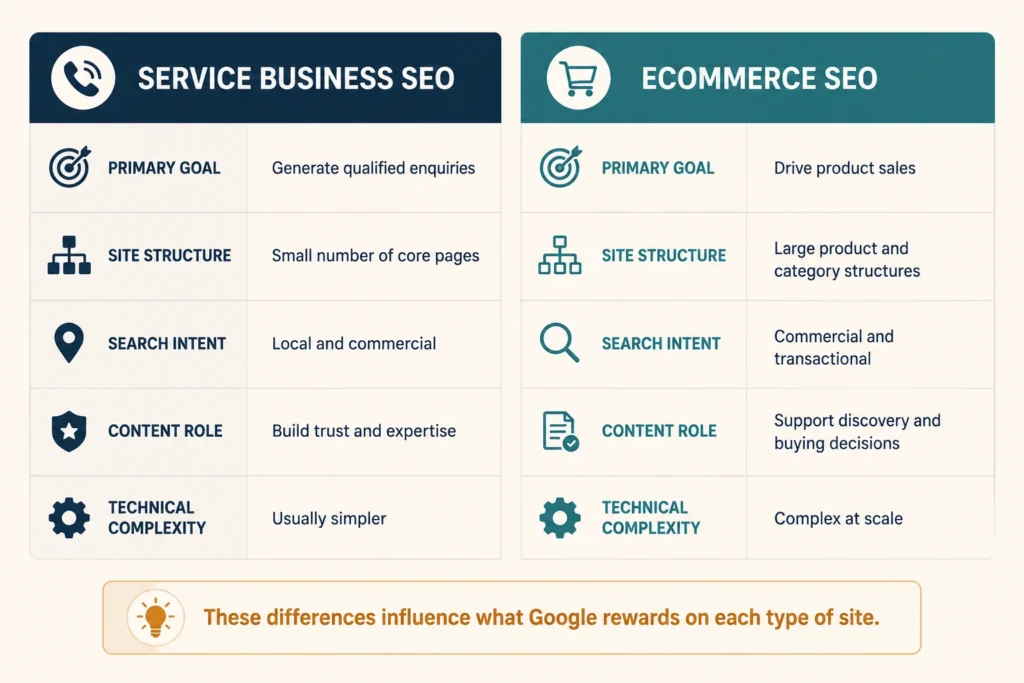
A service business wants Google to send potential customers who are ready to enquire. An ecommerce store, by comparison, wants Google to send shoppers looking for specific products. The table below shows how that difference plays out across the main areas of an SEO strategy.
| Service Business | Ecommerce Store | |
| Primary goal | Generate qualified enquiries | Drive product sales |
| Site structure | A smaller number of core pages | Large product and category structures |
| Search intent | Local, commercial, and informational | Commercial and transactional |
| Content role | Build trust and demonstrate expertise | Support product discovery and buying decisions |
| Local SEO | Often a major channel | Usually limited unless location-based |
| Technical challenges | Usually simpler | More complex due to scale |
These differences influence what Google actually rewards on each type of site. For service businesses, that means content that demonstrates expertise and answers the questions that move a potential customer toward enquiring.
But ecommerce stores have a different goal: their pages need to support product discovery and buying decisions. That means every page has to match a specific search and meet a shopper at the right moment.
Product Pages Must Rank and Convert
Service pages usually have one main conversion goal: convince a visitor to make contact. Product pages, however, have a harder job. They need to attract search traffic and persuade a shopper to buy, all on the same page.
That means your product pages need keyword targeting that helps search engines identify what the page offers. They should also provide enough product detail to convince shoppers to buy. You can achieve this through several elements, including:
- Unique product descriptions
- High-quality product images
- Customer reviews
- Clear product details and specifications
Working with ecommerce stores across Brisbane, we’ve seen how much these pages influence organic performance. Stores that invest in detailed, well-optimised listings are better positioned to attract search traffic and turn visitors into customers.
Category Pages Need Their Own SEO Strategy
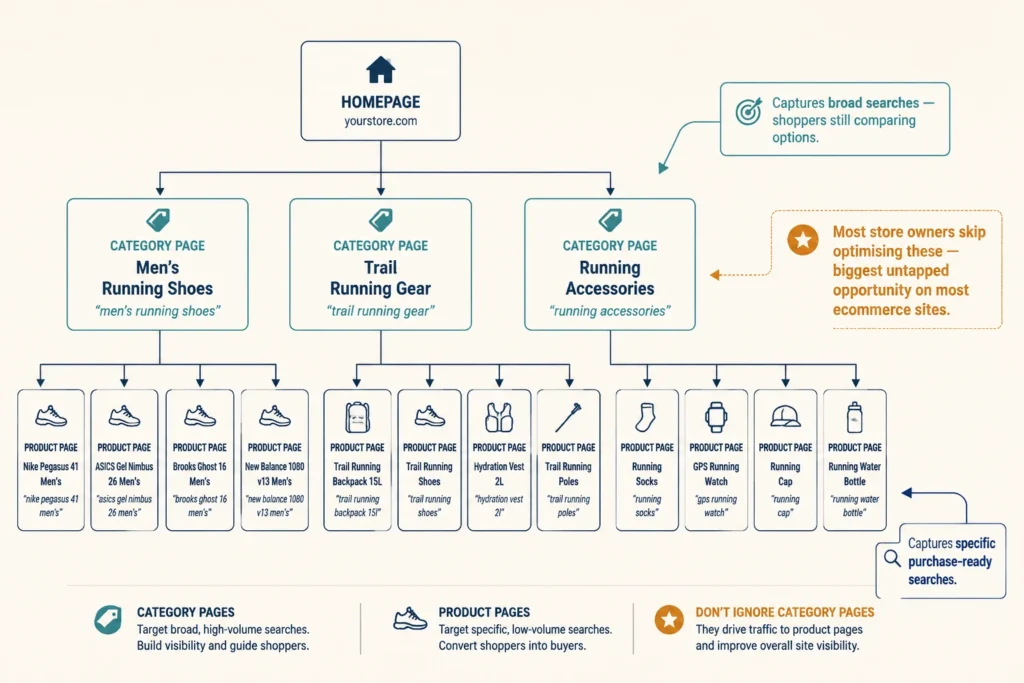
Category pages sit above product pages in the site architecture. They target the broader searches shoppers make before choosing a specific product. For example, someone searching “men’s running shoes” is still comparing options rather than looking for one exact pair. A well-optimised category page captures that search and guides shoppers toward relevant products.
That difference in purpose creates a different SEO task from optimising individual product pages. Product pages target specific searches from shoppers closer to purchase, while category pages compete for broader terms earlier in the buying journey. They need their own keyword research and optimisation strategy to compete for those broader searches effectively.
Most store owners skip this step. They focus their SEO efforts on product pages and blog content while category pages get little more than a product grid. The result is that some of the site’s best opportunities to attract organic traffic are often overlooked.
Technical SEO Is a Bigger Problem on Ecommerce Websites
Technical issues that barely appear on a small service website can become serious SEO problems when an ecommerce catalogue grows. A store with 500 products, for example, can end up with thousands of URLs for Google to crawl. Much of that complexity comes from issues like:
- Out-of-stock products: When you remove a product page because an item sells out, you risk losing the rankings that page has built up over time. Shoppers who follow old links may also land on an error page instead of a product. To avoid that, you need a clear strategy for handling unavailable products, like keeping the page live or redirecting it to a relevant alternative.
- Duplicate URLs from filters and variants: Ecommerce platforms often create multiple URLs for the same product when shoppers filter by colour, size, or price. Without proper canonical tags and indexing controls, search engines may waste time crawling duplicate pages. That pulls focus away from the pages you actually want to rank.
- Performance issues at scale: Large images, product variations, and third-party apps can slow ecommerce sites down. Regular checks through tools like Google Search Console and PageSpeed Insights help identify issues before they affect organic visibility.
- Large site structures: Ecommerce sites need categories, subcategories, and product pages structured so both users and search engines can move through them without confusion. A poorly organised site architecture makes it harder for search engine crawlers to find and index the right pages.
These problems rarely appear on smaller service websites, which is why ecommerce SEO requires ongoing technical management rather than a one-time setup.
What to Prioritise First If You’re Starting From a Service-Site Strategy
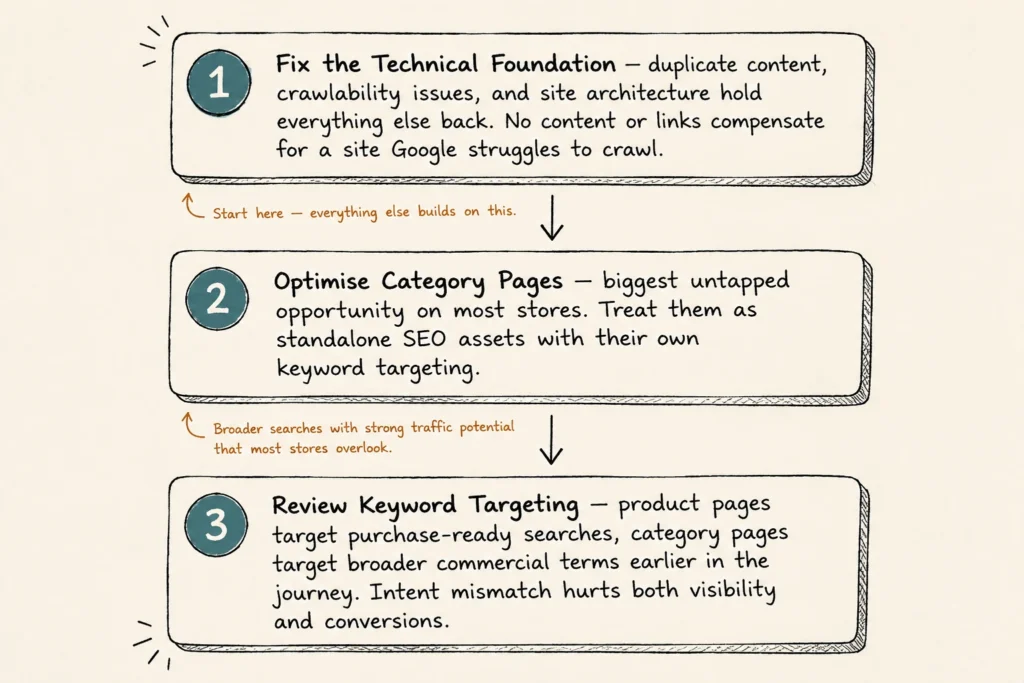
If your store has been following a service-site SEO strategy, you don’t need to rebuild everything at once. The priority is identifying which areas have the most impact on ecommerce performance and addressing those first.
Start with your technical foundation. Technical issues such as duplicate content, crawlability problems, and poor site architecture hold everything else back. No amount of content creation or link building will compensate for a site Google struggles to crawl.
Next, focus on category pages. These pages often represent the biggest untapped opportunity on an ecommerce site. They target broader searches with strong traffic potential and help shoppers discover products before they’ve narrowed their options. Treat them as standalone SEO assets with their own keyword targeting and optimisation strategy.
Then, review your keyword targeting. Product pages should target specific, purchase-ready searches, while category pages focus on broader commercial terms earlier in the buying journey. When the intent behind a search doesn’t match the page trying to rank for it, both visibility and conversions can suffer.
Once you address these areas, you’ll have a strategy built around how your store actually works. That’s when ecommerce SEO starts delivering consistent results.
Your Ecommerce Site Deserves an SEO Strategy Built for It
A service-site SEO strategy was never built for a product catalogue. Applying one to an ecommerce store means overlooking the pages, search intent, and technical challenges that drive organic performance.
The goal is to focus your SEO effort where it has the greatest impact: the pages and opportunities most likely to drive visibility and sales.
If you’re ready to build an ecommerce SEO strategy, BasicLinux can help you identify the highest-impact priorities and map out a clear path forward. Get in touch today for a free strategy session.